
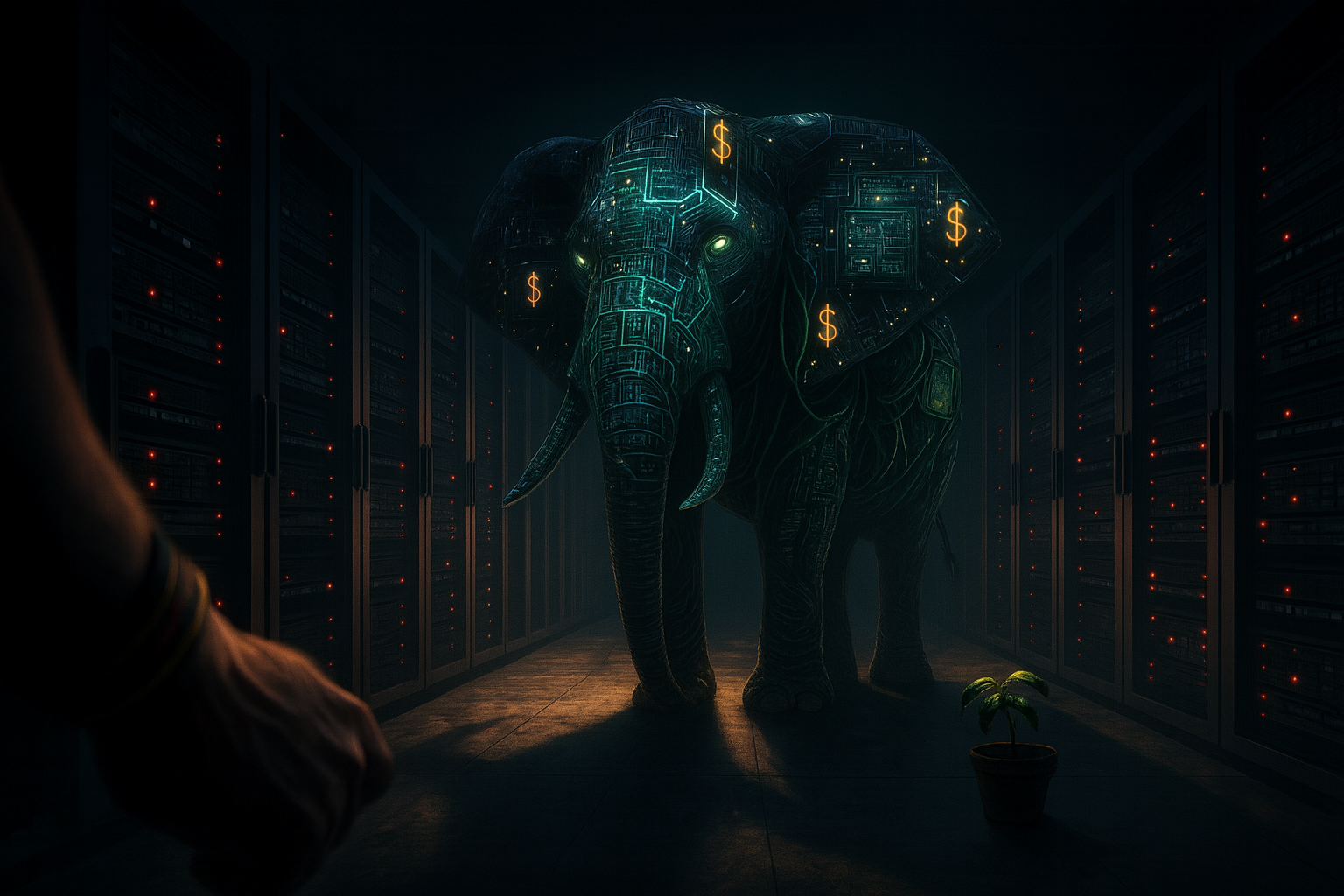
 We’ve spent the week geeking out over the incredible potential of AI. It’s an exhilarating time. But today, we need to talk about the elephant in the room. Or rather, the elephant in the server farm.
Behind the slick demos lies a much more complicated reality. The AI revolution is built on a foundation of staggering costs, a voracious appetite for natural resources, and a wave of disruption that is already reshaping our careers. It’s time to get brutally honest about the true price of intelligence.
The Billion-Dollar Brains: Unpacking the Real Cost of AI
Let’s start with the money. These AI models aren’t magic; they are the product of eye-watering investment. A great example is the recent International Mathematics Olympiad. Both Google’s Gemini and an OpenAI model achieved gold medal scores—a phenomenal achievement. What’s often omitted from the headlines is the cost. Last year, a model that only earned a silver place was estimated to have a compute cost in the region of $300,000 for that single competition.
This is just the tip of the iceberg. The costs to create these models are astronomical:
- Training Costs: Training GPT-4 reportedly cost OpenAI over $100 million, and Google’s Gemini Ultra is estimated to have cost a staggering $191 million. This is a game for giants with nation-state levels of capital.
- Inference Costs: Running the models is a constant drain. API calls to the top-tier models can be incredibly expensive, making large-scale applications a significant financial commitment.
- Talent Costs: The “panic buying of talent,” as I called it on Monday, is real. Top AI engineers command six-figure salaries, and building a team can easily run into the millions. [Billions if you include Zuck’s latest escapades – I’m available for a modest 7 figures Mark – just an fyi]
When you factor it all in, training and deploying a proprietary LLM is a seven-figure-plus endeavour.
The Sustainability Paradox: No Apologies to Greta
This immense financial cost is mirrored by an equally shocking environmental one. For years, the big tech players have been proudly proclaiming their commitments to a carbon-zero future. Microsoft pledged to be carbon negative by 2030. Google has published extensive environmental reports.
And yet, we are facing a fundamental contradiction. The very companies championing these green initiatives are leading an AI arms race that is one of the most resource-intensive technological endeavours in human history.
- Energy Consumption: So, we’ve built these god-like brains, and it turns out they’re thirstier than a tourist on Temple Bar. [Side note from a former Temple Bar employee – in reality tourist would order half a beer to share whilst us locals compensated to ensure Diagio stayed afloat – we’re good like that!] A single ChatGPT query consumes nearly ten times more electricity than a standard Google search. Data centres are seeing their power demands skyrocket, with projections suggesting a 160% increase by 2030, driven largely by AI.
- Water Consumption: This energy use requires a mind-boggling amount of water for cooling. Training GPT-3 alone was estimated to have consumed 700,000 litres of fresh water. Making a few dozen simple requests to a model like ChatGPT can consume a 500ml bottle of water.
- The Hypocrisy: The most damning evidence comes from the companies themselves. Microsoft’s own sustainability report revealed that its emissions have increased by nearly 30% since its 2020 “carbon negative” pledge, primarily due to its AI data center buildout. Worse, an executive recently admitted that burning methane gas would “absolutely not be off the table” to power new data centers, a move that directly contradicts their climate goals.
The Human Equation: The Entry-Level Extinction Event
The final, and perhaps most immediate, cost is the human one. The narrative that “AI will create more jobs than it destroys” is a comforting one, but it masks a brutal reality: we are witnessing an Entry-Level Extinction Event.
The first rung on the career ladder is being sawed off for an entire generation.
- The Data is Stark: The World Economic Forum projected that 85 million jobs would be displaced by 2025. This isn’t a distant forecast. In the first seven months of 2025, over 10,000 job cuts in the US were directly attributed to AI. Job listings for entry-level corporate roles have fallen by 15%.
- Automation is Moving Upstream: This isn’t just about automating factory work. AI is now competent at tasks once considered the domain of white-collar professionals: legal research, coding, and financial analysis. Companies are openly admitting they are replacing junior staff with AI. One consulting firm didn’t hire a summer intern this year because ChatGPT could handle its social media content.
- The New Skill Set: A university degree is no longer enough. Companies want employees who are “productive from day one.” The new, essential skills are not just about technical proficiency but about human-machine collaboration. The most valuable employees will be those who can strategically oversee AI, apply critical thinking to its outputs, and provide the ethical judgment that machines lack. It’s a shift from being an employee who performs tasks to being a “value creator” who orchestrates tools to solve problems.
A Modest Proposal: An AI Tax for the People
So, what do we do? Wringing our hands won’t solve anything. My glass-is-half-full nature demands a constructive path forward.
It’s time we seriously consider an AI Tax.
This isn’t about punishing innovation. It’s about recognizing that a technology generating this much wealth and disruption has a societal obligation. The idea is already being floated, with proposals like New York’s “artificial intelligence surcharge” on corporate income.
The revenue from such a tax could be used to directly address the problems AI creates:
- Fund Public AI Infrastructure: Democratize access and prevent a future where only the wealthy can afford cutting-edge intelligence.
- Fuel Universal Reskilling: Fund the massive, nationwide reskilling programs necessary to prepare the workforce for the new era.
- Strengthen Social Safety Nets: Provide a robust safety net for those whose jobs are permanently displaced.
The immense value flooding into the AI space should be harnessed to build a more equitable and resilient future.
 Cumulus Chatter with a Sprinkle of AI
Leave a comment